Key word transformation practice B2
Key word transformation is one of the four parts of the Use of English module: you rewrite a sentence using a given word, keeping the original meaning, inside a fixed word count — usually between two and five words, including the word itself. Let's look at some examples from a Use of English module worksheet, starting with the excerpt below.
What the task actually checks
It looks like a vocabulary exercise. It mostly isn't. The given word almost always forces a specific grammar structure — passive voice, inversion, reported speech, a comparative, a modal-verb equivalent — so the exercise is really testing whether a student can build that structure correctly, not whether they remember a synonym.
A real example, from an actual worksheet
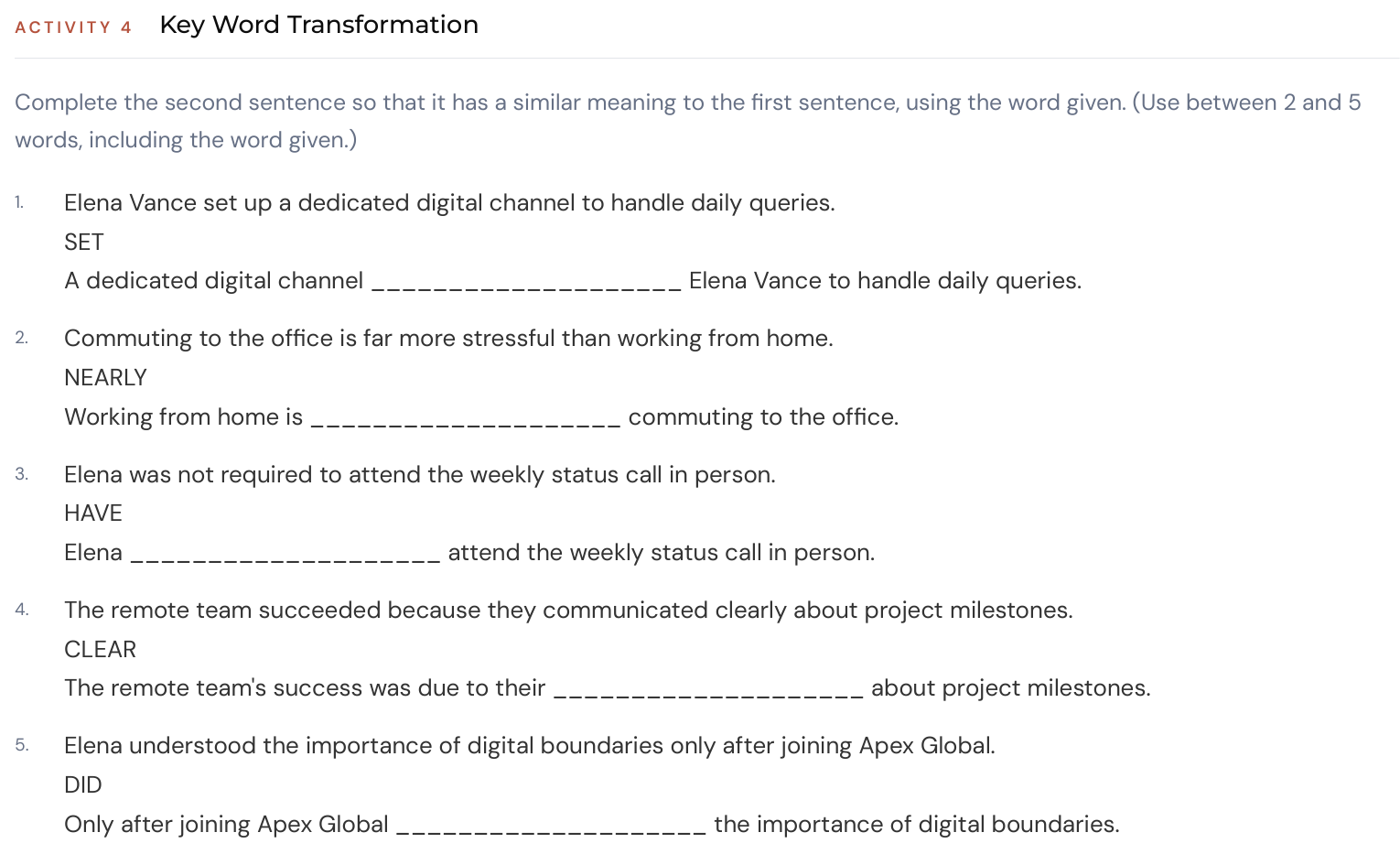
1. Elena Vance set up a dedicated digital channel to handle daily queries.
SET
A dedicated digital channel ___ Elena Vance to handle daily queries.
Answer: was set up by
2. Elena was not required to attend the weekly status call in person.
HAVE
Elena ___ attend the weekly status call in person.
Answer: did not have to
3. Elena understood the importance of digital boundaries only after joining Apex Global.
DID
Only after joining Apex Global ___ the importance of digital boundaries.
Answer: did Elena understand
Common student errors
- Forgetting inversion after a fronted "only after." Item 3 above is the clearest example: students often write "Elena understood" instead of "did Elena understand." Any negative or restrictive adverbial fronted to the start of a sentence triggers the same rule, not just "only after."
- Keeping active voice when the given word forces passive. Item 1 needs "was set up by," not "set up" — the given word SET doesn't mean the sentence stays active.
- Missing the word-count limit. Answers must land inside the stated range (commonly two to five words), including the given word. A grammatically correct answer outside that range still loses the mark.
Questions about key word transformation
How many words can students use? Usually between two and five, including the given word, exactly as stated in the instructions for that item.
Can the given word change form? Yes — SET can become "set up," DID can trigger "did understand." The word family stays the same; the exact form doesn't have to.
Is key word transformation only in the Use of English module? Yes, it's one of that module's four fixed parts.
Make your own
You don't have to write these from scratch. Create your first worksheet — 3 free worksheets, no card required.